
Blog
CA Foundation Maths Important Topics
- 06/07/2026
- Posted by: ecpgurgaon@gmail.com
- Category: CA UPDATES icai
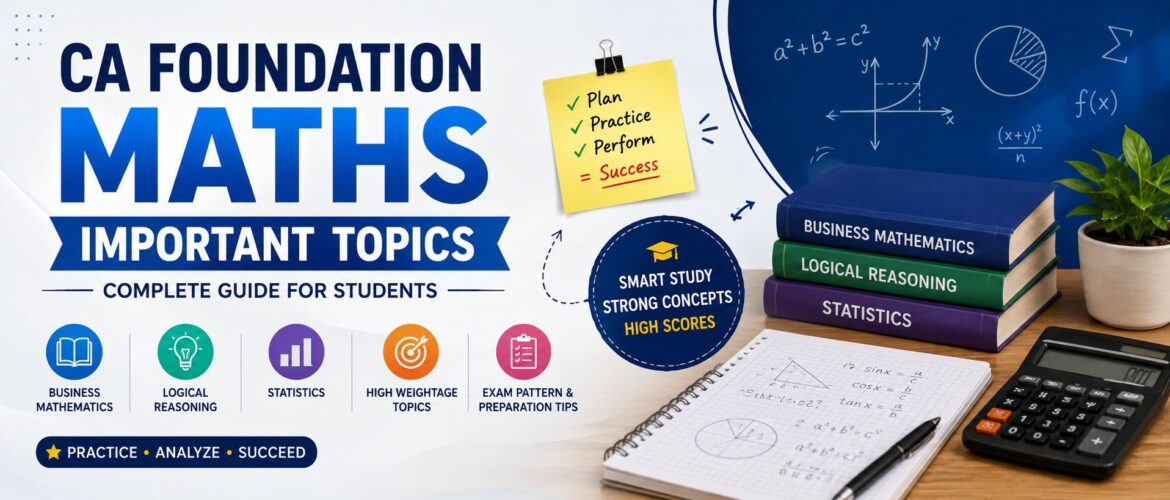
CA Foundation Maths Important Topics – Complete Guide for Students (2026)
Introduction
Preparing for the CA Foundation Mathematics paper can seem challenging at first. However, with the right preparation strategy and a clear understanding of the syllabus, scoring high marks becomes much easier. Since Mathematics is a practical subject, students who practice consistently and focus on important chapters often perform significantly better in the examination.Moreover, ICAI designs the CA Foundation Maths paper to test students’ logical thinking, analytical skills, and problem-solving abilities. Therefore, simply memorizing formulas is not enough. Instead, students should understand concepts, practice multiple questions, and revise regularly.In this detailed guide, you will discover the CA Foundation Maths Important Topics, chapter-wise weightage, preparation tips, common mistakes to avoid, and a smart study strategy to maximize your score.
CA Foundation Maths Paper Pattern
Before starting preparation, it is essential to understand the exam pattern.
- Subject: Business Mathematics, Logical Reasoning & Statistics
- Total Marks: 100
- Question Type: Objective (MCQs)
- Negative Marking: Yes (0.25 mark deducted for every incorrect answer)
- Time Duration: 2 Hours
Since negative marking is applicable, students should not attempt questions through random guessing. Instead, they should answer only when they are reasonably confident.
CA Foundation Maths Syllabus Overview
The paper is divided into three major sections:
A Part – Business Mathematics
This section includes numerical concepts and mathematical techniques used in commerce.
B Part – Logical Reasoning
Students are tested on analytical thinking, reasoning ability, and decision-making skills.
C Part – Statistics
This section focuses on data interpretation, probability, averages, index numbers, and statistical calculations.
Because all three sections contribute significantly to the final score, students should prepare each part thoroughly.
CA Foundation Maths Important Topics
1. Ratio, Proportion and Indices
This chapter forms the foundation of many advanced topics.
Important concepts include:
- Ratio and proportion
- Continued proportion
- Compound ratio
- Variation
- Laws of indices
- Simplification
Since these concepts are basic, students should master them first.
2. Logarithms
Logarithms are frequently asked in the examination.
Focus on:
- Laws of logarithms
- Common logarithms
- Characteristics and mantissa
- Antilogarithms
- Simplification using logarithms
Furthermore, regular practice improves calculation speed considerably.
3. Equations
This chapter carries good scoring opportunities.
Important areas:
- Linear equations
- Simultaneous equations
- Quadratic equations
- Nature of roots
- Word problems
Students should especially practice application-based questions.
4. Linear Inequalities
Although this chapter appears simple, ICAI often asks conceptual questions.
Important topics include:
- Graphical solutions
- Linear inequalities
- Feasible region
- Solution sets
5. Time Value of Money
One of the highest-scoring chapters.
Practice:
- Simple Interest
- Compound Interest
- Present Value
- Future Value
- Annuities
- Discounting
Since formulas play a major role, prepare a separate formula sheet.
6. Permutations and Combinations
This chapter requires conceptual clarity.
Important concepts:
- Fundamental Principle of Counting
- Factorials
- Permutations
- Circular Permutations
- Combinations
- Practical applications
Because students often confuse formulas, continuous revision is essential.
7. Sequence and Series
Frequently asked in ICAI examinations.
Cover:
- Arithmetic Progression (AP)
- Geometric Progression (GP)
- Harmonic Progression (HP)
- Sum of series
- Applications
8. Sets, Relations and Functions
This chapter builds mathematical reasoning.
Important concepts:
- Types of sets
- Operations on sets
- Cartesian products
- Functions
- Relations
- Domain and Range
9. Basic Mathematics of Finance
Students should practice:
- EMI calculations
- Loans
- Investments
- Depreciation
- Financial applications
Since these questions are practical, they are generally scoring.
Logical Reasoning Important Topics
Logical Reasoning usually helps students increase their overall score.
Number Series
Practice identifying:
- Missing numbers
- Patterns
- Sequences
Coding-Decoding
Focus on:
- Letter coding
- Number coding
- Mixed coding
Direction Test
Questions include:
- Distance
- Direction
- Position
Blood Relations
Students should practice family tree questions regularly.
Seating Arrangement
Important areas:
- Circular arrangement
- Linear arrangement
- Ranking
Syllogism
Practice:
- Venn diagrams
- Conclusions
- Statement analysis
Statement and Conclusion
Understand:
- Assumptions
- Conclusions
- Arguments
Calendar and Clock
Although fewer questions appear, these are highly scoring.
Statistics Important Topics
Statistics carries a significant portion of marks.
Measures of Central Tendency
Study:
- Mean
- Median
- Mode
- Weighted Mean
Measures of Dispersion
Important concepts:
- Range
- Quartile Deviation
- Mean Deviation
- Standard Deviation
- Coefficient of Variation
Correlation and Regression
Focus on:
- Positive correlation
- Negative correlation
- Karl Pearson’s coefficient
Probability
One of the most important chapters.
Practice:
- Addition theorem
- Multiplication theorem
- Conditional probability
- Bayes’ theorem
- Independent events
Index Numbers
Prepare:
- Laspeyres Method
- Paasche Method
- Fisher’s Ideal Index
Time Series
Important concepts include:
- Trend analysis
- Moving averages
- Seasonal variations
Chapter-wise Preparation Strategy
Instead of studying randomly, follow this order:
- Ratio & Proportion
- Logarithms
- Equations
- Time Value of Money
- Permutations & Combinations
- Sequence & Series
- Sets & Functions
- Logical Reasoning
- Statistics
This sequence helps build concepts gradually.
Best Study Tips for CA Foundation Maths
To score well, students should follow these effective preparation tips:
- Study Mathematics daily for at least 2 hours.
- Revise formulas every morning.
- Solve ICAI Study Material completely.
- Practice ICAI Mock Test Papers.
- Attempt Previous Year Question Papers.
- Solve MCQs regularly.
- Maintain a separate notebook for formulas.
- Improve calculation speed through regular practice.
- Revise weak chapters every week.
- Attempt full-length mock tests before exams.
Consequently, regular practice helps improve both speed and accuracy.
Common Mistakes Students Should Avoid
Many students lose marks because of avoidable mistakes.
Avoid the following:
- Ignoring Statistics preparation
- Skipping Logical Reasoning
- Memorizing formulas without understanding concepts
- Not solving ICAI questions
- Guessing answers despite negative marking
- Leaving revision until the last week
- Not analyzing mock test performance
Therefore, identifying mistakes early can significantly improve exam performance.
One-Month Revision Plan
1 Week
- Business Mathematics
- Formula revision
- Practice MCQs
2 Week
- Statistics
- Numerical practice
- Previous Year Questions
3 Week
- Logical Reasoning
- Mixed MCQs
- Mock Tests
4 Week
- Full syllabus revision
- ICAI RTPs
- Mock Papers
- Formula revision
- Weak chapter improvement
Following this schedule ensures balanced preparation across all sections.
Recommended Study Material
Students should primarily rely on:
- ICAI Study Material
- ICAI Question Bank
- ICAI Mock Test Papers
- ICAI Revision Test Papers (RTPs)
- Previous Year Question Papers
- Formula Notes
- Chapter-wise MCQ Books
Since ICAI itself prepares these resources, they remain the most reliable source for exam preparation.
Frequently Asked Questions (FAQs)
1. Which are the most important topics in CA Foundation Maths?
The most important topics include Time Value of Money, Permutations & Combinations, Probability, Statistics, Sequence & Series, Equations, Logical Reasoning, and Measures of Central Tendency.
2. Is CA Foundation Maths difficult?
No. Although the syllabus is extensive, consistent practice, conceptual understanding, and regular revision make the subject manageable and highly scoring.
3. How many hours should I study CA Foundation Maths daily?
Ideally, students should devote 1.5 to 2 hours every day to Mathematics while increasing practice during the final revision phase.
4. Is ICAI Study Material enough for CA Foundation Maths?
Yes. ICAI Study Material, Mock Tests, RTPs, and Previous Year Papers are sufficient for strong preparation. However, additional MCQ practice can further improve speed and confidence.
5. Does CA Foundation Maths have negative marking?
Yes. Every incorrect answer attracts a deduction of 0.25 marks, so students should avoid blind guessing.
Conclusion
The CA Foundation Maths Important Topics form the backbone of effective exam preparation. Rather than trying to study everything at once, students should prioritize high-weightage chapters, strengthen conceptual understanding, and practice MCQs consistently. Additionally, solving ICAI Study Material, Mock Test Papers, and Previous Year Questions significantly enhances confidence and exam readiness.
Most importantly, maintain a disciplined study routine, revise formulas regularly, and focus on accuracy to minimize negative marking. With consistent effort and smart preparation, achieving an excellent score in CA Foundation Mathematics is absolutely possible.
FAQ – CA Foundation Maths Important Topics
1. Which chapter should I study first in CA Foundation Maths?
Ideally, you should begin with fundamental chapters such as Ratio & Proportion, Logarithms, and Equations. Once your basics are strong, you can gradually move to advanced topics like Time Value of Money, Permutations & Combinations, and Probability, making your overall preparation much smoother.
2. How can I score 60+ marks in CA Foundation Maths?
To score 60 or more, you should consistently practice ICAI Study Material, solve Previous Year Question Papers, attempt Mock Test Papers, and revise formulas regularly. Furthermore, improving your calculation speed and avoiding unnecessary guesses due to negative marking can significantly increase your score.
3. Are ICAI Previous Year Question Papers important for CA Foundation Maths?
Absolutely! ICAI Previous Year Question Papers help you understand the exam pattern, question types, and difficulty level. Moreover, they allow you to identify frequently tested concepts and improve your confidence before the examination.
4. Is Business Mathematics more important than Logical Reasoning and Statistics?
Not necessarily. Although Business Mathematics carries substantial weight, Logical Reasoning and Statistics are equally important. Therefore, students should prepare all three sections thoroughly to maximize their overall marks.
5. How many questions should I practice daily for CA Foundation Maths?
Generally, solving 40–60 MCQs every day is recommended. In addition, you should regularly revise formulas and analyze your mistakes so that your accuracy improves consistently over time.
6. Can I prepare for CA Foundation Maths without coaching?
Yes, you certainly can. As long as you follow the ICAI Study Material, maintain a disciplined study schedule, practice MCQs daily, and attempt mock tests regularly, self-study can be highly effective. Nevertheless, proper guidance and consistent revision remain essential.
7. Which section is considered the easiest in CA Foundation Maths?
For many students, Logical Reasoning is comparatively easier because it relies more on logical thinking than lengthy calculations. However, with sufficient practice, both Business Mathematics and Statistics can also become highly scoring sections.
8. How often should I revise CA Foundation Maths before the exam?
Ideally, you should revise the complete syllabus at least three to four times before the examination. Additionally, revisiting important formulas and solving mixed MCQs during the final weeks can greatly improve retention and confidence.
9. What are the most common mistakes students make in CA Foundation Maths?
Students often skip regular practice, ignore Statistics, forget to revise formulas, or attempt too many doubtful questions despite negative marking. Therefore, maintaining accuracy, practicing consistently, and reviewing mistakes after every mock test are crucial for success.
10. How should I prepare during the last 15 days before the CA Foundation Maths exam?
During the final 15 days, focus primarily on revision instead of learning new topics. Moreover, solve full-length mock tests, practice important MCQs, revise formulas daily, and review your weak areas. As a result, you will enter the examination with greater confidence and better time-management skills.
11. Which topics are most frequently asked in the CA Foundation Maths exam?
Generally, topics such as Time Value of Money, Probability, Permutations & Combinations, Measures of Central Tendency, Equations, and Logical Reasoning are frequently tested. Therefore, students should prioritize these chapters while ensuring they do not neglect the rest of the syllabus.
12. How important is formula revision for CA Foundation Maths?
Formula revision is extremely important because many questions require quick calculations. Consequently, revising formulas every day not only improves speed but also reduces the chances of making calculation errors during the examination.
13. Should I attempt all questions in the CA Foundation Maths paper?
Not always. Since the paper includes negative marking, you should attempt only those questions for which you are reasonably confident about the answer. As a result, you can maximize your score while minimizing unnecessary deductions.
14. How can I improve my calculation speed for CA Foundation Maths?
To improve calculation speed, practice numerical questions daily, revise basic mathematical concepts, and solve timed MCQ sets. Furthermore, taking regular mock tests will help you become more efficient under exam conditions.
15. Is Statistics difficult in the CA Foundation Maths syllabus?
Statistics may seem challenging initially; however, with consistent practice and a clear understanding of concepts like Mean, Median, Mode, Probability, and Standard Deviation, it becomes much easier and highly scoring.
16. How many mock tests should I take before the CA Foundation Maths exam?
Ideally, you should attempt at least 8–10 full-length mock tests before the examination. In addition, reviewing your mistakes after each test helps identify weak areas and improves overall performance.
17. What is the best way to revise the CA Foundation Maths syllabus?
The most effective revision strategy is to revise chapter-wise formulas, solve important MCQs, practice ICAI Study Material questions, and attempt Previous Year Question Papers. Consequently, you will strengthen both conceptual understanding and exam readiness.
18. Can regular MCQ practice improve my CA Foundation Maths score?
Yes, regular MCQ practice is one of the most effective preparation methods. Moreover, it enhances your speed, accuracy, and familiarity with the exam pattern, which ultimately boosts your confidence on exam day.
19. Which books are best for preparing CA Foundation Maths?
First and foremost, students should rely on the ICAI Study Material, ICAI Mock Test Papers, Revision Test Papers (RTPs), and Previous Year Question Papers. Additionally, a reliable MCQ practice book can further strengthen preparation.
20. What should I do one day before the CA Foundation Maths examination?
Instead of starting new topics, focus on revising important formulas, key concepts, and short notes. Furthermore, solve a few easy MCQs to maintain confidence, get adequate sleep, and stay calm so that you can perform your best during the exam.
21. How much time does it take to complete the CA Foundation Maths syllabus?
Generally, students can complete the CA Foundation Maths syllabus in 2 to 3 months with consistent study. However, the actual duration depends on your current understanding, daily study hours, and regular revision schedule.
22. Is it necessary to solve ICAI Mock Test Papers for CA Foundation Maths?
Yes, it is highly recommended. In fact, ICAI Mock Test Papers closely reflect the actual exam pattern. Therefore, solving them regularly helps improve time management, accuracy, and confidence before the examination.
23. How can I reduce silly mistakes in the CA Foundation Maths exam?
To minimize silly mistakes, carefully read every question, avoid rushing, verify calculations whenever possible, and practice under timed conditions. Additionally, reviewing your answers before submitting the paper can prevent unnecessary mark deductions.
24. Which topics require the most practice in CA Foundation Maths?
Although every chapter is important, topics such as Probability, Permutations & Combinations, Time Value of Money, Equations, and Statistics require extensive practice. Consequently, students should allocate extra time to these areas during preparation.
25. Is daily formula revision necessary for CA Foundation Maths?
Absolutely. Since many questions are formula-based, revising formulas every day improves recall speed and calculation accuracy. Moreover, maintaining a dedicated formula notebook can make revision much more effective.
26. How should I manage time during the CA Foundation Maths examination?
Firstly, attempt the easiest questions to secure quick marks. Thereafter, move to moderate and difficult questions while keeping track of time. Most importantly, avoid spending too long on a single question because it may affect your overall performance.
27. Can I pass the CA Foundation Maths exam by studying only important topics?
While important topics deserve extra attention, relying solely on them is not advisable. Instead, you should cover the complete syllabus because ICAI can ask questions from any chapter. Nevertheless, focusing more on high-weightage topics can improve your scoring potential.
28. How often should I solve Previous Year Question Papers for CA Foundation Maths?
Ideally, you should solve Previous Year Question Papers multiple times during your preparation. Furthermore, practicing them under actual exam conditions helps you understand question patterns and improve your problem-solving speed.
29. What is the best strategy for the final week before the CA Foundation Maths exam?
During the final week, prioritize full-syllabus revision, formula review, mock tests, and important MCQs. Additionally, avoid learning completely new concepts, as this may create unnecessary confusion before the examination.
30. Why is regular practice essential for CA Foundation Maths?
Regular practice strengthens conceptual understanding, improves calculation speed, and increases accuracy. As a result, students become more confident while solving MCQs and are better prepared to handle the pressure of the actual CA Foundation examination.
31. How can I improve my accuracy in the CA Foundation Maths exam?
To improve accuracy, practice chapter-wise MCQs regularly, analyze every incorrect answer, and revise formulas consistently. Furthermore, attempting timed practice tests helps reduce errors while improving both speed and confidence.
32. Is a calculator allowed in the CA Foundation Maths examination?
No, calculators are not permitted in the CA Foundation examination. Therefore, students should regularly practice manual calculations so they can solve numerical questions quickly and accurately during the exam.
33. How should beginners start preparing for CA Foundation Maths?
If you are a beginner, start by understanding the basic concepts instead of memorizing formulas. Thereafter, study one chapter at a time, solve practice questions daily, and gradually move on to advanced topics. As a result, your conceptual foundation will become much stronger.
34. What is the best revision strategy for CA Foundation Maths formulas?
The most effective approach is to maintain a separate formula notebook and revise it every day. Additionally, applying those formulas while solving MCQs reinforces your understanding and improves long-term retention before the examination.
35. Can consistent practice alone help me score well in CA Foundation Maths?
Yes, consistent practice plays a vital role in achieving a high score. However, it should be combined with conceptual clarity, regular revision, and ICAI Study Material. Consequently, this balanced approach significantly increases your chances of scoring excellent marks in the CA Foundation Maths exam.
36. Why should I solve chapter-wise MCQs before attempting full-length mock tests?
Above all, solving chapter-wise MCQs helps you strengthen individual concepts before testing your overall preparation. Consequently, you can identify weak areas early, thereby making your mock test performance much more effective and result-oriented.
37. How can I remember important Maths formulas for a longer period?
To begin with, prepare a dedicated formula notebook and revise it daily. Furthermore, write down formulas repeatedly and apply them while solving practice questions. As a result, your retention improves significantly, thus helping you recall formulas quickly during the examination.
38. Is time management really important in the CA Foundation Maths exam?
Undoubtedly, effective time management is one of the biggest factors behind a high score. Therefore, begin with easier questions, move to moderately difficult ones, and leave lengthy calculations for later. Ultimately, this strategy helps you attempt more questions accurately within the allotted time.
39. What should I do if I find a particular Maths chapter difficult?
Instead of skipping the chapter, break it into smaller topics and study one concept at a time. Additionally, watch concept-based lectures, solve basic questions first, and gradually increase the difficulty level. Eventually, your confidence will improve, therefore making even challenging chapters easier to understand.
40. How can I maximize my score in CA Foundation Math on the exam day?
Most importantly, stay calm and read every question carefully before answering. Moreover, attempt only those questions you are confident about because of negative marking. Meanwhile, manage your time wisely, review your answers whenever possible, and avoid unnecessary guesswork. Consequently, you can maximize both your accuracy and your overall score in the CA Foundation Maths examination.
41. How early should I start preparing for the CA Foundation Maths exam?
Ideally, you should begin your preparation at least 3–4 months before the examination. This way, you will have sufficient time to complete the syllabus, practice MCQs, revise formulas, and attempt mock tests. Consequently, your confidence and accuracy will improve considerably.
42. Why is conceptual understanding more important than memorizing formulas?
Although formulas are essential, understanding the underlying concepts is even more important. In other words, conceptual clarity enables you to solve application-based questions with ease. Therefore, focus on learning the logic behind every formula instead of simply memorizing it.
43. Should I make short notes while preparing for CA Foundation Maths?
Yes, you definitely should. Not only do short notes help you revise quickly, but they also highlight important formulas, shortcuts, and tricky concepts. As a result, your final revision becomes much faster and more effective.
44. How can I stay motivated while preparing for CA Foundation Maths?
At times, preparation may feel overwhelming. Nevertheless, setting small daily goals, tracking your progress, and celebrating minor achievements can keep you motivated. Moreover, maintaining a consistent study routine helps build confidence over time.
45. Is solving Previous Year Question Papers enough for CA Foundation Maths?
Previous Year Question Papers are extremely valuable. However, they should be combined with ICAI Study Material, Mock Test Papers, and regular MCQ practice. Only then can you develop a comprehensive understanding of the syllabus and exam pattern.
46. What should I do if I score low in my mock tests?
First of all, don’t get discouraged. Instead, analyze every mistake carefully and identify the chapters where you lost marks. Thereafter, revise those topics thoroughly and attempt another mock test. Eventually, your performance will improve with consistent effort.
47. How can I improve my speed without compromising accuracy?
To achieve both speed and accuracy, practice under timed conditions every day. At the same time, review your incorrect answers and understand why mistakes occurred. Consequently, you will become faster while maintaining a high level of precision.
48. Which revision technique works best for CA Foundation Maths?
One of the most effective techniques is the multiple revision method. Initially, revise within 24 hours of studying a topic. Subsequently, revise after one week and again before the examination. This approach, therefore, strengthens long-term memory and improves recall.
49. How important are full-length mock tests before the CA Foundation Maths exam?
Full-length mock tests are extremely important because they simulate the actual examination environment. Besides improving your time management, they also help reduce exam anxiety and identify weak areas. Hence, students should attempt several mocks before the final exam.
50. What is the biggest secret to scoring high in CA Foundation Maths?
Above all, consistency is the key to success. Not only should you study regularly, but you should also revise formulas, solve ICAI Study Material, practice MCQs, and analyze your mistakes. Ultimately, this disciplined approach will significantly increase your chances of scoring excellent marks in the CA Foundation Maths examination.