
Blog
How to Study CA Foundation Law
- 25/08/2026
- Posted by: ecpgurgaon@gmail.com
- Category: ca foundation notes CA UPDATES icai
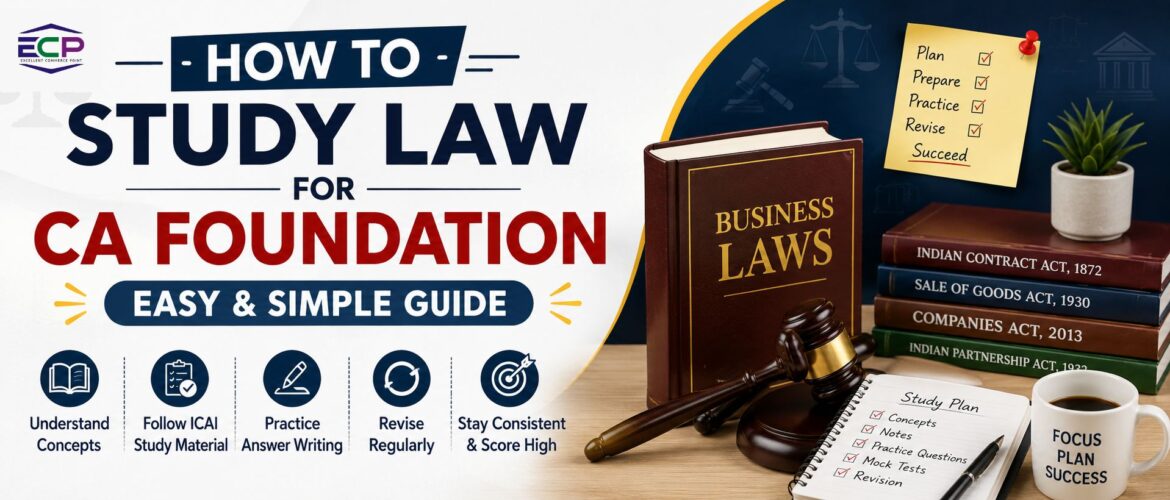
How to Study Law for CA Foundation: Easy & Simple Guide
Studying CA Foundation Law may seem challenging at first. However, once you understand the concepts instead of memorising them, the subject becomes much easier. In fact, Law is one of the highest-scoring papers in the CA Foundation exam because most questions are concept-based and directly linked to the ICAI syllabus. How to Study CA Foundation Law ?
If you are wondering how to study Law for CA Foundation, this guide will help you with practical strategies, smart revision techniques, answer-writing tips, and effective study habits. By following these methods consistently, you can prepare confidently and score excellent marks in the examination.
Why Is Law Important in CA Foundation?
Before learning how to study Law for CA Foundation, it is important to understand why this subject deserves your attention.
- It builds a strong foundation for CA Intermediate and CA Final.
- It develops your analytical and logical thinking skills.
- It teaches legal principles used in business and everyday life.
- It offers an excellent opportunity to improve your overall CA Foundation score.
Therefore, developing a clear understanding of Law from the beginning will make your CA journey much smoother.
1. Understand the CA Foundation Law Syllabus
The first step is to become familiar with the latest ICAI syllabus. Once you know what to study, planning becomes much easier.
The syllabus mainly includes:
Indian Contract Act, 1872
This is the most important portion of the syllabus. It explains contracts, agreements, consideration, breach of contract, and remedies.
Sale of Goods Act, 1930
This chapter covers the legal aspects of buying and selling goods, including conditions, warranties, ownership, and rights of buyers and sellers.
Indian Partnership Act, 1932
Here, you learn about partnership firms, partners’ rights and duties, admission, retirement, and dissolution.
Limited Liability Partnership (LLP) Act, 2008
This is a comparatively shorter chapter that explains the concept and features of LLPs.
Companies Act, 2013 (Basic Concepts)
This section introduces companies, their types, incorporation, and basic legal provisions.
Once you understand the syllabus, you can prepare a structured study plan without confusion.
2. Begin with Easier Chapters
Instead of starting with the longest chapter, begin with topics that are easier to understand.
A good sequence is:
- Sale of Goods Act
- LLP Act
- Companies Act
- Partnership Act
- Indian Contract Act
As a result, your confidence improves, making it easier to tackle more detailed chapters later.
3. Learn Through Practical Examples
Law becomes interesting when you relate it to real-life situations.
For example:
A offers to sell a laptop to B. B accepts the offer. Once all legal conditions are fulfilled, the agreement becomes a valid contract.
Using practical examples helps you:
- Understand concepts faster.
- Remember legal provisions longer.
- Write better examination answers.
Consequently, revision also becomes much easier.
4. Prepare Short and Effective Notes
Avoid writing lengthy notes. Instead, prepare concise revision notes for every chapter.
Your notes should include:
- Important definitions
- Key legal provisions
- Frequently asked concepts
- Important exceptions
- Flowcharts
- Comparison tables
- ICAI keywords
Moreover, these notes will save valuable time during the final revision.
5. Learn Important Sections Smartly
Many students worry about remembering section numbers. Fortunately, ICAI focuses more on conceptual understanding than rote memorisation.
Therefore:
- Learn only the frequently tested sections.
- Associate each section with a practical example.
- Revise important sections regularly.
Focus especially on:
- Important Contract Act provisions
- Sale of Goods definitions
- Partnership essentials
- Basic Company Law concepts
This strategy helps you retain information more effectively.
6. Complete the ICAI Study Material
The ICAI Study Material should always be your primary source.
To prepare effectively:
- Read every chapter carefully.
- Underline important points.
- Solve all illustrations.
- Attempt every back question.
- Practice RTPs and MTPs.
- Solve Previous Year Question Papers.
Since ICAI often frames questions directly from its study material, completing it thoroughly significantly improves your chances of scoring well.
7. Practice Answer Writing Regularly
Reading alone is not enough. You must also practice presenting answers properly.
Use this simple structure:
- Begin with a brief introduction.
- Explain the legal provision.
- Support it with an example.
- End with a clear conclusion.
This format improves clarity and helps examiners award better marks.
8. Follow a Three-Step Revision Strategy
Revision is the key to success in Law.
A simple revision plan is:
- First Revision – Immediately after completing a chapter.
- Second Revision – Within one week.
- Third Revision – Before the examination.
As a result, concepts remain fresh in your memory and revision becomes much faster.
9. Connect Law with Everyday Life
Relating legal concepts to daily activities makes learning enjoyable.
For example:
- Buying groceries → Sale of Goods Act
- Ordering food online → Contract Act
- Starting a business with friends → Partnership Act
- Registering a company → Companies Act
Therefore, you will remember concepts naturally without excessive memorisation.
10. Attempt Mock Tests
Mock tests are essential for exam preparation.
Ideally, attempt:
- One test after completing 50% of the syllabus.
- One test after completing the entire syllabus.
- One final mock test before the examination.
Mock tests help you:
- Improve writing speed.
- Identify weak areas.
- Build confidence.
- Manage time effectively.
11. Prepare One-Page Revision Sheets
During the last few days before the exam, reading complete chapters is difficult.
Instead, prepare one-page revision sheets containing:
- Important definitions
- Key legal provisions
- Important sections
- Frequently asked concepts
- Quick examples
These sheets make last-minute revision extremely efficient.
12. Stay Consistent Every Day
Consistency always beats last-minute preparation.
A simple daily schedule can be:
- 1 Hour – Study new concepts
- 30 Minutes – Solve practice questions
- 20 Minutes – Revise previous topics
- 10 Minutes – Review important definitions
Even studying regularly for 30–40 days can help you complete the syllabus confidently.
Final Thoughts
Understanding how to study Law for CA Foundation is not about memorising every provision. Instead, it is about understanding concepts, practising questions, revising consistently, and relying on ICAI Study Material.
If you follow these simple techniques with discipline, Law can become one of your highest-scoring subjects. Stay consistent, revise regularly, and trust your preparation. With the right approach, success in the CA Foundation Law paper is well within your reach.
Frequently Asked Questions (FAQs)
1. Is Law difficult in CA Foundation?
No. Law becomes easy when you understand concepts instead of memorising them. Regular revision and answer-writing practice make the subject much simpler.
2. Should I memorise all the section numbers?
No. Focus on understanding concepts first. Learn only the most important sections that are frequently tested by ICAI.
3. Which book is best for CA Foundation Law?
The ICAI Study Material is the most important resource. You should also practise RTPs, MTPs, and Previous Year Question Papers.
4. How many revisions are enough for Law?
At least three revisions are recommended to retain concepts effectively before the examination.
5. Can I score above 60 marks in CA Foundation Law?
Yes. By understanding concepts, practising answer writing, revising regularly, and studying ICAI material thoroughly, scoring 60+ marks is completely achievable.
6. How many hours should I study Law every day for CA Foundation?
Ideally, you should study 1.5 to 2 hours daily. However, the quality of your study matters more than the number of hours. Therefore, focus on understanding concepts, solving questions, and revising regularly instead of simply reading the textbook.
7. Is it necessary to learn all the section numbers?
No, it is not necessary to memorise every section number. Instead, concentrate on understanding the legal concepts and learn only the important and frequently asked sections. As a result, you will remember the provisions more effectively during the examination.
8. Which chapter is the most important in CA Foundation Law?
The Indian Contract Act, 1872 carries significant weight in the examination. Nevertheless, you should never ignore other chapters because ICAI asks questions from the entire syllabus. Therefore, prepare every chapter thoroughly.
9. Can I prepare CA Foundation Law in one month?
Yes, you can complete the preparation in one month if you follow a disciplined study plan. However, you should study consistently, revise regularly, and solve ICAI questions every day. Consequently, your confidence and accuracy will improve.
10. Should I study from coaching notes or ICAI Study Material?
Although coaching notes are helpful for quick revision, the ICAI Study Material should always remain your primary source. Moreover, many examination questions are directly based on ICAI concepts and illustrations.
11. How can I remember legal definitions easily?
The best way is to understand the meaning first and then revise it repeatedly. Additionally, using flashcards, flowcharts, and practical examples can help you retain definitions for a longer period.
12. Are Previous Year Question Papers enough for preparation?
Previous Year Question Papers are extremely important because they help you understand the examination pattern. However, they should be used along with the ICAI Study Material, RTPs, and MTPs for complete preparation.
13. How often should I revise CA Foundation Law?
Ideally, revise every chapter immediately after completing it. Afterward, revise it again after one week and once more before the examination. This revision cycle significantly improves long-term retention.
14. How can I improve my answer-writing skills in Law?
First, understand the concept thoroughly. Then, practise writing answers in a structured format with an introduction, legal provision, explanation, example, and conclusion. Consequently, your presentation becomes more professional and examiner-friendly.
15. Does handwriting affect marks in CA Foundation Law?
Although beautiful handwriting is not compulsory, neat and readable handwriting certainly creates a positive impression. Furthermore, proper spacing, headings, and bullet points make your answers easier to evaluate.
16. What are the most common mistakes students make while studying Law?
Many students memorise without understanding concepts, skip revisions, ignore ICAI Study Material, and avoid answer-writing practice. Therefore, focus on conceptual learning and consistent revision to avoid these mistakes.
17. Is daily revision more important than studying new chapters?
Yes. While learning new topics is essential, regular revision ensures that previously studied concepts remain fresh in your memory. As a result, you are less likely to forget important provisions during the examination.
18. Can I score above 70 marks in CA Foundation Law?
Absolutely. If you understand the concepts, use ICAI keywords, revise consistently, solve mock tests, and present your answers clearly, scoring 70+ marks is entirely possible.
19. How should I revise Law during the last week before the exam?
During the final week, avoid starting new topics. Instead, revise your short notes, important definitions, frequently tested sections, ICAI illustrations, and mock test mistakes. Consequently, you will enter the examination with greater confidence.
20. What is the best strategy to score high in CA Foundation Law?
The best strategy is to study from the ICAI Study Material, understand concepts instead of rote learning, practise Previous Year Question Papers, attempt mock tests, and revise multiple times. Most importantly, remain consistent throughout your preparation because daily effort leads to long-term success.